Habits
5 min read

Michael
Author

Motivation feels powerful, but it’s unreliable. Some days you wake up ready to train, work, study, or perform, while on others even relatively simple tasks require considerably more effort. If your ability to follow through depends primarily on how motivated you feel, your consistency will inevitably fluctuate with your energy, mood, stress and circumstances.
High performers don’t eliminate these fluctuations. Instead, they create routines and environments that make it easier to execute the right behaviors even when motivation is low. Over time, those behaviors require less conscious effort and become part of what you simply do. That is where habits become powerful.
Motivation Gets You Started. Habits Keep You Going.
Think about the last time you decided to make a major change. Perhaps you wanted to train five times per week, completely change your diet, meditate every morning or study for two hours every day. During the first few days, motivation makes these changes relatively easy because the goal is new, progress feels exciting and you’re actively thinking about what you want to achieve.
Eventually, however, normal life gets in the way. You’re tired, work takes longer than expected, progress slows down or something more interesting competes for your attention. Suddenly, the behavior that initially felt easy requires considerable effort, and this is exactly where relying purely on motivation becomes problematic.
Motivation naturally changes with your mood, energy, stress, sleep and environment. A good system reduces how much motivation you need in the first place by making the desired behavior more predictable and increasingly automatic. Instead of repeatedly asking yourself, “Do I feel like doing this today?”, the behavior gradually becomes “This is simply what I do.”
1. Start Smaller Than You Think
One of the biggest mistakes when building a new habit is trying to change too much at once. Someone who barely exercises might decide that starting Monday they will train six times per week, completely change their nutrition and establish a perfect morning routine at the same time. The plan may be ambitious, but ambition doesn’t necessarily make a behavior sustainable.
A better approach is often to start below what you believe you’re capable of. Begin with two workouts per week and add another once they have become part of your normal schedule. Instead of starting with 30 minutes of meditation every morning, begin with five. Rather than rebuilding your entire diet overnight, improve one meal that you eat regularly.
Starting small can feel almost too easy, but that is often precisely the point. Your first objective isn’t to create the perfect routine; it’s to establish a behavior that survives beyond the initial burst of motivation. The best habit isn’t the most impressive one. It’s the one you can actually maintain.
2. Make the Right Behavior Easier
We often think about discipline as a matter of willpower, yet our environment constantly influences the decisions we make. If your phone is sitting next to you while you’re working, ignoring it requires repeated self-control; if it’s in another room, many of those decisions disappear before they have to be made.
The same principle applies to almost every behavior. If you want to exercise in the morning, prepare your training clothes the night before. If you want to improve your nutrition, make healthy food easily available rather than relying on yourself to make the optimal decision when you’re already hungry. If you want to work with greater focus, remove unnecessary notifications before you begin. If reviewing your performance is important, schedule a fixed time for it rather than waiting until you happen to feel motivated.
These changes may seem insignificant individually, but together they reduce the effort required to initiate the behaviors you want to maintain. Since getting started is often the most difficult part, even small reductions in friction can make consistency easier.
Don’t just increase discipline. Reduce friction.
3. Decide in Advance
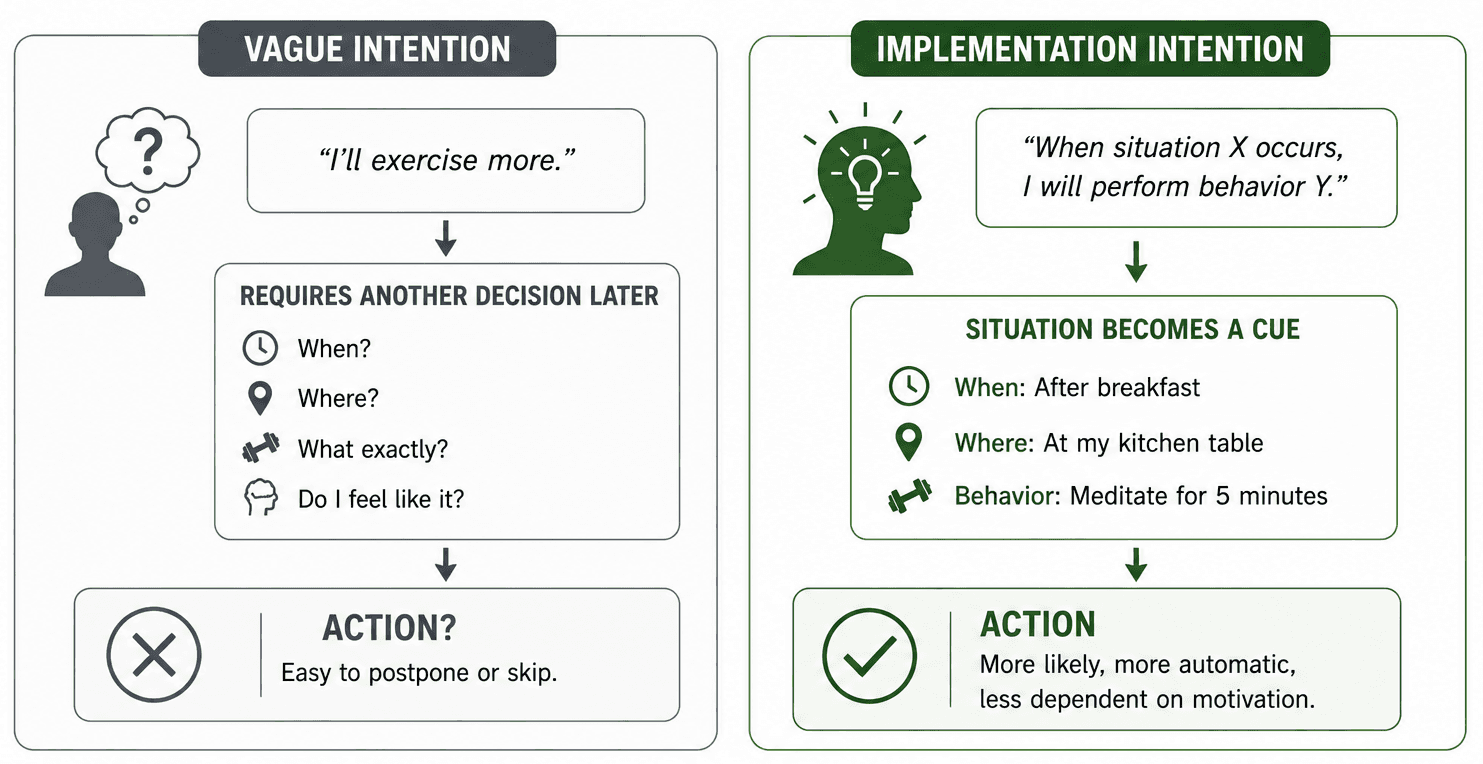
Many habits fail because the desired behavior remains too vague. “I’ll exercise more,” “I’ll eat healthier,” or “I’ll work on my mental game” may express good intentions, but they still leave you with multiple decisions to make every time you want to act.
A more effective approach is to define in advance when and where the behavior will happen. Instead of planning to meditate more often, decide that you’ll meditate for five minutes after breakfast. Instead of intending to exercise three times per week, schedule your workouts for Monday, Wednesday and Friday at 6 PM. Instead of vaguely planning to improve your decision-making, establish a routine in which you review three difficult decisions after every session.
A major meta-analysis by Gollwitzer and Sheeran (2006) examined implementation intentions across numerous studies and found that these if–then plans can help translate intentions into action and improve goal achievement.
Based on Gollwitzer & Sheeran (2006)
The advantage is simple: you’re removing decisions from the moment when your motivation may already be low. Rather than deciding every day whether you’re going to perform the behavior, you’ve already made that decision when you created the system.
4. Create a Minimum Version for Bad Days
Consistency doesn’t require your routine to look identical every day. In fact, having a smaller version of an important behavior can make your system more resilient when circumstances aren’t ideal.
Imagine your normal workout takes an hour, but after a stressful day you only have the time or energy for twenty minutes. It can be tempting to conclude that if you can’t complete the entire workout, there is little point in doing anything at all. From the perspective of building consistency, however, that shorter workout can still be valuable because you maintain the underlying behavior instead of abandoning it completely.
The same principle works elsewhere. If you can’t meditate for fifteen minutes, do five. If you don’t have time for your complete review, analyze one important decision. If preparing your ideal meal isn’t realistic, choose the best practical alternative available.
This isn’t about permanently lowering your standards. It’s about having a minimum version of the behavior that keeps your system functioning when life becomes difficult. Your best days may determine how much you can accomplish, but your difficult days often determine whether you remain consistent long enough to make meaningful progress.
5. Focus on Repetition Before Optimization
High performers naturally want to optimize. They want to know the perfect training program, the ideal morning routine, the best nutrition strategy or the most effective mental preparation technique. These can all be useful questions, but optimization becomes far less important when the underlying behaviors aren’t performed consistently.
A theoretically perfect routine performed twice and then abandoned isn’t necessarily better than a simple routine maintained for months. When you’re establishing a new behavior, your first objective should therefore be to make it repeatable, and only once repetition has become reliable should you invest heavily in optimization.
Five minutes of daily practice can eventually become ten, two weekly workouts can become three, and one simple performance review can gradually develop into a more sophisticated review system. Consistency creates the foundation on which optimization becomes useful.
6. Track the Process, Not Just the Outcome
Results matter, but they often appear much later than the behaviors responsible for them. You can train consistently without immediately becoming stronger, improve your decision-making without immediately seeing better financial results, or change your nutrition without noticing an instant transformation in the mirror. When outcomes are the only measure of progress, periods without visible improvement can easily make it feel as though your efforts aren’t working.
This is why it can be useful to track the behaviors you actually control alongside the results they eventually produce. Ask yourself whether you completed your training, followed your routine, reviewed your decisions or executed the process you had committed to. Doing so creates a different definition of a successful day: rather than judging yourself exclusively by the outcome, you also evaluate the quality of your execution.
Research on behavior-change interventions supports the usefulness of self-monitoring in some contexts. In a meta-regression of interventions targeting healthy eating and physical activity, Michie et al. (2009) found that self-monitoring was among the behavior-change techniques associated with more effective interventions, particularly when combined with other self-regulatory techniques.
This doesn’t mean that outcomes should be ignored. Results remain essential for determining whether your system is actually effective and whether it needs to be adjusted. On a daily basis, however, execution is usually much more directly under your control. For anyone operating in an environment where short-term outcomes are uncertain — particularly sport, poker or trading — that distinction becomes especially important.
7. Don’t Aim for Perfect Consistency
Consistency doesn’t mean never missing a workout, breaking a routine or making a poor decision. Trying to maintain that standard is unrealistic and can even become counterproductive because a single deviation starts to feel like failure.
The more important question is how quickly you return to the behavior. One missed workout won’t destroy your fitness, one unhealthy meal won’t ruin your nutrition and one poor performance won’t erase your progress. Problems emerge when one deviation turns into a week and that week gradually turns into a month.
Instead of treating consistency as an uninterrupted streak, think of it as the ability to repeatedly return to the behaviors that matter. High performers aren’t necessarily perfect at maintaining their routines; they’re good at getting back on track.
8. Build Systems That Work on Bad Days
It’s relatively easy to execute when you’re rested, confident, making visible progress and excited about your goal. Those conditions make the right behavior naturally attractive, which means they aren’t the real test of whether your system works.
The more revealing moments come when you’re tired, confidence is low, work becomes stressful, progress has stalled or the initial excitement has disappeared. A system that functions only when motivation is high isn’t particularly robust because it depends on favorable conditions remaining in place.
Sustainable improvement therefore isn’t about forcing yourself to produce maximum output every day. Sometimes the appropriate response is to reduce your workload, recover or adjust your plan. What matters is that you have a structure that repeatedly brings you back to the behaviors that move you in the right direction.
That’s why long-term improvement isn’t built around maximizing motivation. It’s built around making useful behaviors simple, repeatable and increasingly automatic.
Use motivation when it’s there. Let it help you start something new, pursue an ambitious goal or make an important change, but don’t build a system that depends on feeling motivated every day.
Because meaningful progress rarely comes from one extraordinary day.
It comes from executing the right behaviors on hundreds of ordinary ones.
Sources:
Wood, W. (2019). Good Habits, Bad Habits: The Science of Making Positive Changes That Stick. Farrar, Straus and Giroux.
Clear, J. (2018). Atomic Habits: An Easy & Proven Way to Build Good Habits & Break Bad Ones. Avery.
Gollwitzer, P. M., & Sheeran, P. (2006). Implementation intentions and goal achievement: A meta-analysis of effects and processes. Advances in Experimental Social Psychology, 38, 69–119.
Singh, B. et al. (2024). Time to form a habit: A systematic review and meta-analysis of health behaviour habit formation and its determinants. Healthcare.
Michie, S., Abraham, C., Whittington, C., McAteer, J., & Gupta, S. (2009). Effective techniques in healthy eating and physical activity interventions: A meta-regression. Health Psychology, 28(6), 690–701.