Decision Making
6 min read

Michael
Author

You start the day sharp. Decisions feel relatively easy, your attention stays where you want it, and you can work through complex problems without much resistance. Several hours later, however, the same tasks can feel noticeably harder. You reread information, become more easily distracted, lose patience with details or start making decisions faster simply because you want to get them over with.
This experience is often described as mental fatigue: a psychobiological state that can develop after prolonged periods of demanding cognitive activity. It doesn’t necessarily mean that you’re physically exhausted or unable to continue working. Instead, sustained mental effort becomes increasingly difficult, the subjective cost of concentrating rises and certain aspects of cognitive or skilled performance may begin to deteriorate. Research in sport, for example, has associated mental fatigue with poorer decision-making, reaction time and accuracy, although the magnitude of these effects depends on the task and individual (Habay et al., 2021).
For anyone whose performance depends on making hundreds of good decisions over several hours — whether in sport, poker, trading, studying or demanding professional work — understanding mental fatigue is therefore not simply about feeling less tired. It’s about protecting the quality of your decisions as the hours accumulate.
Mental Fatigue Is More Than Feeling Tired
Mental fatigue often develops gradually. After prolonged concentration, problem-solving, monitoring or decision-making, you may still be perfectly capable of continuing the task, but maintaining the same level of engagement begins to require more effort. This distinction is important because subjective fatigue can appear before performance completely breaks down.
In practice, the first signs may be subtle. You might become less willing to analyze marginal situations, find yourself checking your phone more frequently, feel increasingly irritated by interruptions or notice that difficult decisions suddenly seem disproportionately demanding. Instead of carefully comparing several options, you may become attracted to whichever one allows you to move on fastest.
This is one reason mental fatigue can be difficult to recognize in real time. You don’t suddenly lose the ability to think; maintaining high-quality thinking simply becomes more demanding. That means a person can continue working for hours while gradually operating below the quality they produced earlier in the day.
Why Decision Quality Can Decline
Complex decisions require several cognitive processes to work together. You need to maintain relevant information in working memory, suppress impulsive or irrelevant responses, shift between different possibilities and keep attention focused long enough to evaluate the situation properly. These abilities overlap with what psychologists describe as executive functions.
When you’re mentally fresh, using these processes may feel relatively effortless. After hours of cognitively demanding activity, however, maintaining the same degree of cognitive control can become more difficult. The result doesn’t necessarily have to be an obviously irrational decision. More often, deterioration appears in smaller ways: reduced patience, less information processing, poorer accuracy, slower or sometimes unnecessarily faster responses, and a greater tendency to fall back on simple or habitual strategies.
Recent evidence from sport illustrates the potential magnitude of the problem. A 2026 systematic review and meta-analysis (Lu et al., 2026) found mental fatigue was associated with poorer sport-related decision-making performance, with the decision-making findings showing a particularly consistent pattern across the included studies.
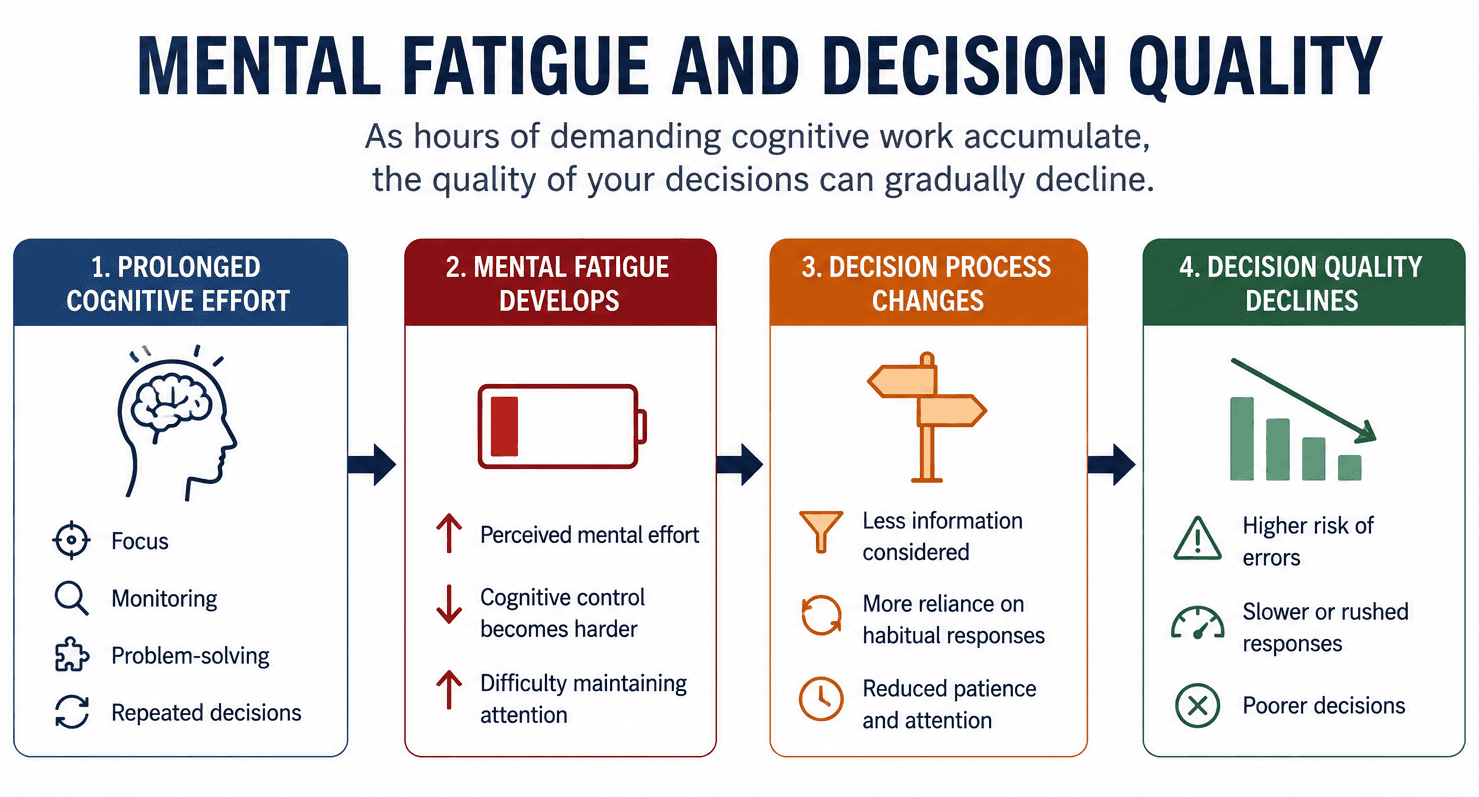
Concept based on Lu et al. (2026).
The precise effects shouldn’t automatically be generalized from sport to every professional environment, but the underlying message is relevant: when a task requires continuous attention and repeated complex decisions, cognitive state can become part of performance.
The Same Decision Can Become Harder Later
Imagine making the same difficult decision twice: once shortly after starting work and once after five hours of continuous concentration. The available information may be identical, yet your experience of the decision can be very different.
Earlier in the day, you might patiently evaluate several possibilities before choosing. Later, the same analysis can feel disproportionately effortful, which creates a temptation to simplify the process. You might rely more heavily on intuition, overlook information that would normally attract your attention or simply choose an acceptable solution instead of continuing to search for the best one.
In poker, this could mean carefully analyzing a marginal river decision early in the session but relying increasingly on an immediate impression after several hours of play. In trading, it could mean becoming less disciplined about entry criteria after continuously monitoring markets. In sport, it may appear as slower or less accurate tactical decisions toward the later stages of competition.
This doesn’t mean intuition or fast decision-making is inherently bad. Experienced performers often develop extremely effective automatic processes. The problem arises when your decision process changes because you’re fatigued rather than because the situation actually calls for a different approach.
Mental Fatigue Can Affect Physical Performance Too
The consequences of prolonged cognitive effort aren’t necessarily limited to purely mental tasks. Research has also examined whether mental fatigue influences subsequent physical performance.
A major systematic review (Van Cutsem et. al, 2017) found that mental fatigue was associated particularly with impaired endurance performance, while maximal strength, power and anaerobic work were generally unaffected. Interestingly, many traditional physiological markers of exercise capacity did not substantially change. Instead, one of the most consistent findings was an increase in perceived effort: after mentally demanding activity, the same physical work can feel harder.
This is an important distinction. Your physical capabilities may not suddenly disappear, but your experience of the effort required to access them can change. A later bias-sensitive meta-analysis challenged how large and robust some of these exercise effects actually are after accounting for potential publication bias, so the evidence shouldn’t be interpreted as meaning that mental fatigue inevitably destroys physical performance.
The practical point is more nuanced: mental and physical workloads aren’t completely independent. A day filled with cognitively demanding work can potentially influence how subsequent training feels and, depending on the task, how well you perform.
Not All Work Creates the Same Mental Load
Six hours of work doesn’t necessarily produce the same amount of mental fatigue as another six hours of work. The nature of those hours matters.
Passive or familiar activities generally place different demands on the brain than sustained concentration, inhibition, monitoring and complex decision-making. Switching constantly between tasks, responding to notifications, solving difficult problems and continuously evaluating uncertain information can create a very different cognitive workload from completing familiar tasks with few interruptions.
This is particularly relevant in high-performance environments because people often measure workload primarily in hours. A five-hour session involving constant difficult decisions may be more cognitively demanding than a longer session in which much of the activity is routine.
Instead of asking only “How long have I been working?”, it can therefore be useful to ask “How cognitively demanding have the last few hours actually been?”
That distinction becomes especially important when scheduling your most consequential decisions.
1. Protect Your Best Cognitive Hours
If your cognitive capacity isn’t perfectly stable throughout the day, it makes little sense to treat every working hour as equally valuable. Rather than simply maximizing the amount of time spent working, try to match the difficulty of the task to the quality of your current cognitive state.
When possible, use periods in which you’re mentally fresh for tasks requiring deep concentration, learning, strategic thinking or complex decision-making. Lower-value administrative tasks, routine reviews and organizational work can often be moved to periods when cognitive capacity is lower.
This doesn’t mean that everyone needs to perform important work first thing in the morning. Individual rhythms and schedules differ. The principle is simply to identify when your decision quality tends to be highest and protect part of that time for your highest-value cognitive work.
For a poker player, that may mean avoiding unnecessary mentally demanding activities immediately before an important session. For an athlete, it may mean considering the cognitive demands placed before training or competition. For someone doing knowledge work, it could mean protecting a two-hour block for difficult analytical work rather than spending the first part of the day reacting to emails and notifications.
2. Use Breaks Before You Feel Completely Exhausted
People often take breaks reactively: they continue until concentration has already collapsed and only then step away. A more effective approach can be to treat breaks as part of the performance system rather than as something you earn once you’ve worked hard enough.
The purpose of a break isn’t simply to stop working. It is to temporarily reduce the cognitive demands responsible for fatigue. That means replacing a difficult task with ten minutes of equally stimulating digital activity may not provide the same kind of disengagement as actually stepping away from the information stream.
A short walk, some movement, food when needed or simply spending a few minutes away from screens and active decision-making can create a clearer separation between work blocks. The exact optimal break structure depends on the person and task, so there is little reason to turn one arbitrary schedule into a universal rule.
More importantly, breaks shouldn’t become an excuse to ignore excessive workload. Recovery strategies can support sustained performance, but they cannot make unlimited cognitive work free of cost.
3. Create Decision Rules Before Fatigue Appears
One of the most useful ways to protect performance is to make important decisions about your behavior before you’re mentally fatigued.
Suppose you know that after several hours of poker you become more impulsive and start extending sessions when you shouldn’t. Deciding whether to continue at that exact moment places another important decision into the hands of the fatigued version of yourself. A predefined session limit, stop criterion or mandatory review point reduces that problem.
The same principle applies elsewhere. Traders can establish risk limits before the market opens, athletes can create routines for specific competition situations, and professionals can define criteria for when an important decision should be postponed rather than forced through late in the day.
The objective isn’t to remove flexibility. It’s to avoid repeatedly solving predictable problems under the exact conditions in which your decision-making may be least reliable.
Use your fresh mind to build rules that protect your fatigued mind.
4. Monitor Decision Quality, Not Just Output
A common mistake in performance environments is to evaluate productivity primarily through quantity: hours worked, hands played, trades made, pages studied or tasks completed. Those numbers are easy to measure, but they don’t necessarily tell you whether the additional volume remained valuable.
If the first four hours of a session contain excellent decisions and the next two contain progressively more mistakes, maximizing total volume may actually reduce the quality of the overall performance. The relevant question isn’t simply how long you can continue; it is how long you can continue while maintaining an acceptable standard of execution.
This is where simple performance tracking becomes useful. Look for patterns in errors, attention, emotional control and decision quality across different stages of your sessions. Perhaps mistakes increase after a certain amount of time, after several difficult decisions in succession or when sleep and previous workload are poor.
Over time, those patterns can help you distinguish between feeling tired and actually performing worse. That distinction matters because subjective fatigue and objective performance don’t always move perfectly together.
Mental Endurance Is Part of Performance
The solution to mental fatigue isn’t to avoid demanding cognitive work. Just as physical training creates fatigue, serious cognitive performance requires effort. The objective is to understand that cognitive capacity is a resource that should be managed rather than assumed to remain constant indefinitely.
That means structuring demanding work intelligently, protecting your strongest cognitive periods, taking meaningful breaks, using predefined rules for predictable situations and monitoring whether decision quality changes as sessions progress. It also means accepting that sometimes the highest-performance decision is not to squeeze another hour out of the day, but to stop before the quality of that hour becomes too low.
Mental endurance can certainly be developed through experience and appropriate training, but high performers shouldn’t rely exclusively on their ability to tolerate fatigue. A strong performance system also reduces unnecessary fatigue and protects important decisions from being made under poor conditions.
The goal isn’t simply to stay productive for as long as possible.
It’s to keep the quality of your thinking high for as long as it matters.
Sources:
Boksem, M. A. S., & Tops, M. (2008). Mental fatigue: Costs and benefits. Brain Research Reviews, 59(1), 125–139.
→ Broad scientific review of mental fatigue, cognitive control, motivation and the mechanisms proposed to explain why sustained mental effort becomes increasingly difficult.Van Cutsem, J., Marcora, S., De Pauw, K., Bailey, S., Meeusen, R., & Roelands, B. (2017). The effects of mental fatigue on physical performance: A systematic review. Sports Medicine, 47(8), 1569–1588.
→ Useful for the connection between cognitive workload, perceived effort and subsequent physical performance.Habay, J., Van Cutsem, J., Verschueren, J., et al. (2021). Mental fatigue and sport-specific psychomotor performance: A systematic review. Sports Medicine, 51(7), 1527–1548.
→ Reviews the effects of mental fatigue on areas particularly relevant to performance, including decision-making, reaction time and accuracy.Lu, Q., Liu, D., Chen, X., Wang, J., Song, Y., & Chai, Y. (2026). Effects of mental fatigue on sport-related reaction-time, technical, and decision-making performance: A systematic review and meta-analysis. BMC Psychology, 14(1), 1118.
→ Very recent meta-analysis finding poorer reaction-time, technical and decision-making performance under mental fatigue, with particularly consistent results for decision-making.Levitin, D. J. (2014). The Organized Mind: Thinking Straight in the Age of Information Overload. Dutton.
→ Accessible further reading on attention, information overload, organization and managing cognitive demands in everyday life.