Recovery
7 min read

Michael
Author

We tend to associate progress with effort. If we want to get fitter, we train harder; if we want to achieve more professionally, we work longer or concentrate more intensely; and when an important competition, project or deadline approaches, the natural response is often to increase the amount of effort we invest. Effort matters, but focusing exclusively on this side of the equation ignores an equally important part of sustainable performance: our ability to recover from the demands we create.
Every difficult training session, stressful working day, competition or period of sustained concentration produces some combination of physical, mental and emotional fatigue. When sufficient recovery follows, we can return ready to perform again; when recovery repeatedly falls short, fatigue and stress can accumulate, making it increasingly difficult to maintain the same quality of attention, decision-making and physical performance.
Recovery should therefore not be understood simply as doing nothing. It is the process through which we reduce accumulated demands and restore our capacity to perform effectively again. This applies whether you’re an athlete preparing for competition, someone making demanding decisions in poker or trading, or simply trying to combine a stressful job with exercise, family and everyday responsibilities.
Performance Is a Cycle
The human body and brain aren’t designed to operate at maximum intensity indefinitely. Physical training deliberately creates stress because adaptation requires a stimulus, but performing another demanding training session before sufficiently recovering from the previous one can reduce the quality of subsequent training (Kellmann et al., 2018). More training therefore isn’t automatically better training; what matters is the relationship between the stress you create and your ability to adapt to it.
The same principle applies to cognitive work. A day filled with meetings, deadlines, problem-solving and difficult decisions can be exhausting even though you’ve barely moved physically. You may still be capable of continuing to work, but concentration becomes more effortful, patience decreases and decisions that felt manageable earlier in the day suddenly require considerably more mental energy.
Fatigue itself isn’t necessarily a problem. Some degree of fatigue is an expected consequence of meaningful work and training. The more important question is whether your daily and weekly routines provide enough opportunity to recover before another demanding period begins.
Instead of asking only “How much more can I do today?”, it can therefore be useful to occasionally ask:
“What do I need to be ready to perform well again tomorrow?”
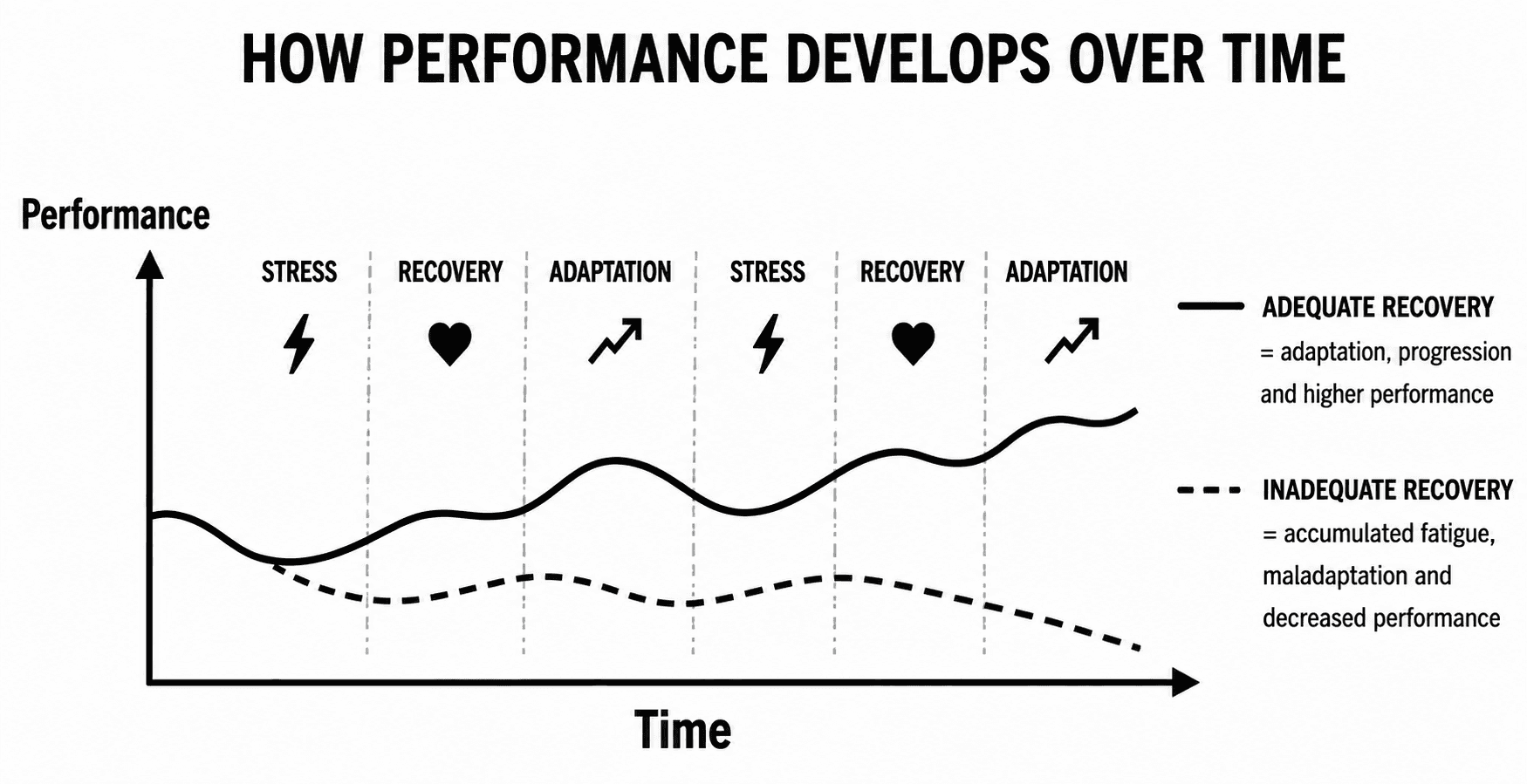
Concept based on: Kellmann, M. et al. (2018).
Recovery Is More Than Physical Rest
Recovery is often associated primarily with physical rest, but the demands we experience aren’t exclusively physical. Occupational psychology provides a useful framework by distinguishing between recovery experiences such as psychological detachment, relaxation, mastery and control over how we spend our free time.
Psychological detachment means mentally disengaging from work or another demanding activity rather than continuing to think about it throughout the evening. Relaxation reduces activation, while mastery experiences involve engaging in activities outside your primary demands that provide learning, challenge or a sense of accomplishment. Control refers to having some freedom over how you spend your recovery time.
Meta-analytic research (Bennett et al., 2018; Headrick et al., 2023) suggests that these experiences are associated with outcomes such as fatigue, exhaustion and well-being. Psychological detachment appears particularly relevant to reducing negative outcomes such as exhaustion, while relaxation and mastery experiences show positive relationships with several personal and work-related outcomes.
This means that recovery can look very different depending on what created the fatigue in the first place. After eight hours of cognitively demanding work, exercise may actually feel restorative because it shifts the type of demand. After an exhausting physical training session, sitting down with a book or spending time with friends may provide exactly that change.
The relevant question isn’t simply “Am I resting?” but rather “Am I getting a break from the demands that exhausted me?”
Recovery Also Means Processing Emotional Load
There is another form of fatigue that is particularly relevant whenever outcomes matter: emotional load.
A difficult day doesn’t always end when the activity ends. A trader may close the platform after a significant loss but continue mentally replaying decisions for the rest of the evening. A poker player may leave a bad session frustrated about mistakes, bad decisions or results outside their control. An athlete can finish a disappointing competition and continue experiencing frustration or disappointment long afterward, while a difficult interaction with a colleague or manager can remain mentally active even after you’ve left work.
If experiences like these repeatedly occur without sufficient psychological recovery, the emotions associated with them can carry over into subsequent periods. Research on recovery from work is consistent with the broader idea that psychological detachment is associated with less exhaustion and fatigue and better well-being, although the relationship between recovery experiences and actual performance is more complex (Wendsche & Lohmann-Haislah, 2017).
For performance, this matters because yesterday’s emotional response can become part of today’s starting condition. If frustration from one poker session is still active when the next begins, decisions may no longer be evaluated from a neutral psychological state. A trader who remains emotionally attached to a previous loss may become excessively cautious or overly motivated to recover it. An athlete who continues to replay a poor competition may enter the next training session with reduced confidence, while unresolved work stress can make normal problems feel disproportionately frustrating the following morning.
Recovery therefore provides an opportunity not only to reduce physical and cognitive fatigue, but also to let emotional activation settle instead of continuously carrying it forward.
Process the Experience Instead of Replaying It
Emotional recovery doesn’t mean suppressing negative emotions or forcing yourself to think positively. Frustration, disappointment and anger can contain useful information, particularly when something genuinely went wrong. The goal is to distinguish productive reflection from repetitive rumination.
After a difficult performance, ask what actually happened, identify anything you can learn from it and decide what needs to change. A poker player might review whether a large loss came from poor decisions, normal variance or a combination of both. An athlete can identify what went wrong in competition and what should be addressed in training, while someone who experienced a difficult day at work can decide whether the problem requires action or simply needs to be accepted.
Once the useful information has been extracted, however, repeatedly replaying the same experience rarely adds much. At that point, continued engagement can keep the emotional response active without producing additional learning.
A simple end-of-performance routine can help create that distinction:
What happened? What can I learn from it? What will I do differently? Is there anything else I can meaningfully do about it today?
Once those questions have been answered, recovery can begin. The objective isn’t to erase the emotion immediately but to give it space to decrease rather than continuously feeding it with additional analysis.
Learn to Mentally Switch Off
This leads to one of the most important concepts in recovery research: psychological detachment. You can physically stop an activity without psychologically leaving it. Technically, the performance period has ended, but psychologically very little has changed.
A large meta-analysis (Wendsche & Lohmann-Haislah, 2017) involving more than 38,000 employees found that greater psychological detachment from work was associated with less exhaustion and fatigue, better sleep and greater well-being, although associations with actual work performance were generally smaller and more complex.
Switching off doesn’t mean that you care less about what you’re doing. It means recognizing that continued engagement eventually reaches a point of diminishing returns. Once you’ve reviewed what needs to be reviewed and planned what needs to happen next, continuing to think about the problem isn’t necessarily continuing to solve it.
Sleep Is the Foundation
Recovery techniques can become surprisingly complicated, but one fundamental remains difficult to replace: sleep.
Sleep is relevant to cognitive functioning, emotional regulation and physical recovery, making it important whether your main demands come from sport, work or both. Athletes face additional challenges because late competitions, early training sessions, travel and pre-competition arousal can interfere with sleep, while similar problems occur in everyday life when deadlines, shift work, stress or late-night work reduce the opportunity to recover.
Research in athletes has found that sleep interventions such as sleep extension and napping can improve sleep and may benefit aspects of subsequent physical and cognitive performance, although the quality and size of the evidence varies between interventions (Bonnar et. al, 2018)
For most people, however, improving recovery doesn’t require turning sleep into another optimization project. The more useful questions are usually simpler: Does your schedule provide enough opportunity to sleep? Are you regularly sacrificing sleep to extend working or training hours? Do work, competition or emotionally difficult sessions follow you into bed?
The objective isn’t perfect sleep every night. Individual nights naturally vary, and becoming anxious about achieving an ideal sleep score can itself become counterproductive. Consistency matters more than perfection.
Match Recovery to the Stress You Created
There isn’t one universal recovery strategy because there isn’t one universal form of fatigue.
After a physically demanding training session, sleep, nutrition, hydration and appropriate management of subsequent training load may be the primary priorities. After several hours of cognitively demanding work, reducing further cognitive stimulation and psychologically detaching may be more valuable. After an emotionally difficult competition, trading day or poker session, you may physically feel fine while still carrying substantial psychological activation.
A useful starting point is therefore:
What am I recovering from — physical fatigue, mental fatigue, emotional load, or a combination of them?
If you’ve spent ten hours sitting at a computer, movement may be more restorative than spending the entire evening on another screen. If you’ve completed an exhausting endurance session, physical rest becomes more important. If frustration from a difficult day remains the primary problem, neither sitting on the couch nor using a recovery gadget necessarily addresses it; you may first need to process what happened and create psychological distance from it.
Recovery works best when it responds to the type of stress you’ve actually experienced.
Schedule Recovery Before You’re Exhausted
One of the most common mistakes is waiting until fatigue becomes severe before changing anything. Recovery then becomes an emergency response to exhaustion rather than a normal component of the week.
A more sustainable approach is to anticipate demanding periods. If you know that Wednesday contains a particularly difficult training session, Thursday’s workload can reflect that. If you’re preparing for an exam, continuous twelve-hour study days aren’t necessarily optimal simply because the exam matters. If you know that an important poker session, trading day, competition or presentation is likely to be emotionally demanding, leaving some space afterward can make it easier to process the experience rather than immediately moving into the next demanding task.
Planning recovery also protects you from a paradox of motivation: when things are going well, stopping can be hardest. Someone working on an exciting project may continue late into the night, an athlete may want to add another training session and a poker player may extend a session because the games are good.
Stopping at an appropriate point can therefore require discipline too.
Recovery isn’t always what you do when you can no longer continue. Sometimes it’s what allows you to continue tomorrow.
Learn Your Own Recovery Signals
Generic recommendations provide a useful starting point, but recovery eventually becomes individual. Some people notice insufficient recovery primarily through physical fatigue, while others experience reduced concentration, irritability, lower motivation, disturbed sleep or an unusual increase in perceived effort.
Emotional signals matter as well. If small setbacks suddenly create unusually strong frustration, if you’re carrying yesterday’s disappointment into today’s decisions or if normal challenges start feeling disproportionately stressful, accumulated emotional load may be part of the picture.
The objective isn’t to interpret every bad mood or difficult day as evidence that you need more recovery. Human performance naturally fluctuates. Instead, look for patterns across time.
Perhaps your decision-making becomes less disciplined after several demanding days. Maybe your training quality consistently deteriorates when sleep has been poor. Perhaps emotional reactions become stronger when you’ve had several difficult sessions without a meaningful break.
Those patterns can help you build a recovery strategy based on how you actually respond, rather than following generic rules.
Recovery Protects Consistency
The greatest benefit of recovery isn’t simply feeling relaxed. It’s being able to repeatedly do the things that matter to you at a sufficiently high level.
One excellent workout doesn’t create fitness, one productive day doesn’t build a career, and one good competition or decision doesn’t determine long-term results. Progress comes from accumulating useful training sessions, productive working days and good decisions over months and years.
This changes the way recovery should be evaluated. If working another two hours tonight substantially reduces the quality of tomorrow’s work, those hours may not be as productive as they appear. If another hard training session reduces the quality of the next several sessions, more training hasn’t necessarily produced more progress. And if you repeatedly carry frustration from one performance into the next, failing to emotionally recover can turn one bad experience into several.
There will always be periods when pushing harder is appropriate. Competitions, deadlines, exams and ambitious projects sometimes require temporarily higher workloads, and developing the ability to tolerate these periods is valuable.
But temporary overload and permanent overload are not the same strategy.
Recovery Is Part of the Work
Effort is visible. Recovery usually isn’t.
We notice the person staying late at work, the athlete completing another difficult training session or the student studying throughout the weekend. What we rarely see is the sleep, downtime, emotional processing and deliberate reduction in workload that allow those efforts to be repeated.
Recovery shouldn’t be used as an excuse to avoid difficult work, nor should every sign of fatigue be treated as a reason to stop. Meaningful goals require effort, and periods of physical, cognitive and emotional fatigue are normal.
The skill lies in recognizing when more effort remains productive and when recovery becomes the more productive choice.
Protect your sleep. Create periods in which you genuinely switch off. Process difficult experiences instead of endlessly replaying them. Match your recovery to the physical, cognitive and emotional demands you’ve experienced, and don’t assume sophisticated recovery techniques can compensate for weak fundamentals.
Because sustainable performance isn’t determined only by how hard you can work.
It’s also determined by how consistently you can recover, reset and come back ready to do it again.
Sources:
Kellmann, M., Bertollo, M., Bosquet, L., et al. (2018). Recovery and performance in sport: Consensus statement. International Journal of Sports Physiology and Performance, 13(2), 240–245.
→ General scientific framework for the relationship between stress, recovery and performance in sport.Bennett, A. A., Bakker, A. B., & Field, J. G. (2018). Recovery from work-related effort: A meta-analysis. Journal of Organizational Behavior, 39(3), 262–275.
→ Meta-analysis covering psychological detachment, relaxation, mastery and control as recovery experiences.Wendsche, J., & Lohmann-Haislah, A. (2017). A meta-analysis on antecedents and outcomes of detachment from work. Frontiers in Psychology, 7, 2072.
→ Particularly relevant to psychological detachment and its relationships with fatigue, exhaustion, sleep and well-being.Headrick, L., Newman, D. A., Park, Y. A., & Liang, Y. (2023). Recovery experiences for work and health outcomes: A meta-analysis and recovery-engagement-exhaustion model. Journal of Business and Psychology, 38, 821–864.
→ Large meta-analysis examining recovery experiences and personal as well as work-related outcomes.Bonnar, D., Bartel, K., Kakoschke, N., & Lang, C. (2018). Sleep interventions designed to improve athletic performance and recovery: A systematic review of current approaches. Sports Medicine, 48, 683–703.
→ Systematic review covering sleep interventions and their potential effects on recovery and subsequent performance.Li, S., Kempe, M., Brink, M., & Lemmink, K. (2024). Effectiveness of recovery strategies after training and competition in endurance athletes: An umbrella review. Sports Medicine – Open, 10, 55.
→ Umbrella review useful for putting specialized physical recovery strategies into perspective.