Performance Under Pressure
7 min read

Michael
Author

You know what you’re capable of. You’ve trained, prepared and put in the work, and under normal conditions the skills you need may feel reliable and familiar. Yet when the moment suddenly matters—a decisive moment, a large financial decision, an important presentation or any situation in which failure feels costly—something can change. Your heart rate rises, thoughts become faster, attention shifts toward possible consequences and decisions that normally feel automatic suddenly require conscious effort.
This is one of the frustrating characteristics of pressure: your underlying ability may be exactly the same while your ability to access and execute it changes. Research on choking under pressure suggests that performance can deteriorate partly because pressure changes how attention is allocated. Instead of remaining focused on task-relevant information, attention may be captured by worries and consequences, or performers may begin consciously controlling skills that normally operate relatively automatically (Gröpel & Mesagno, 2019).
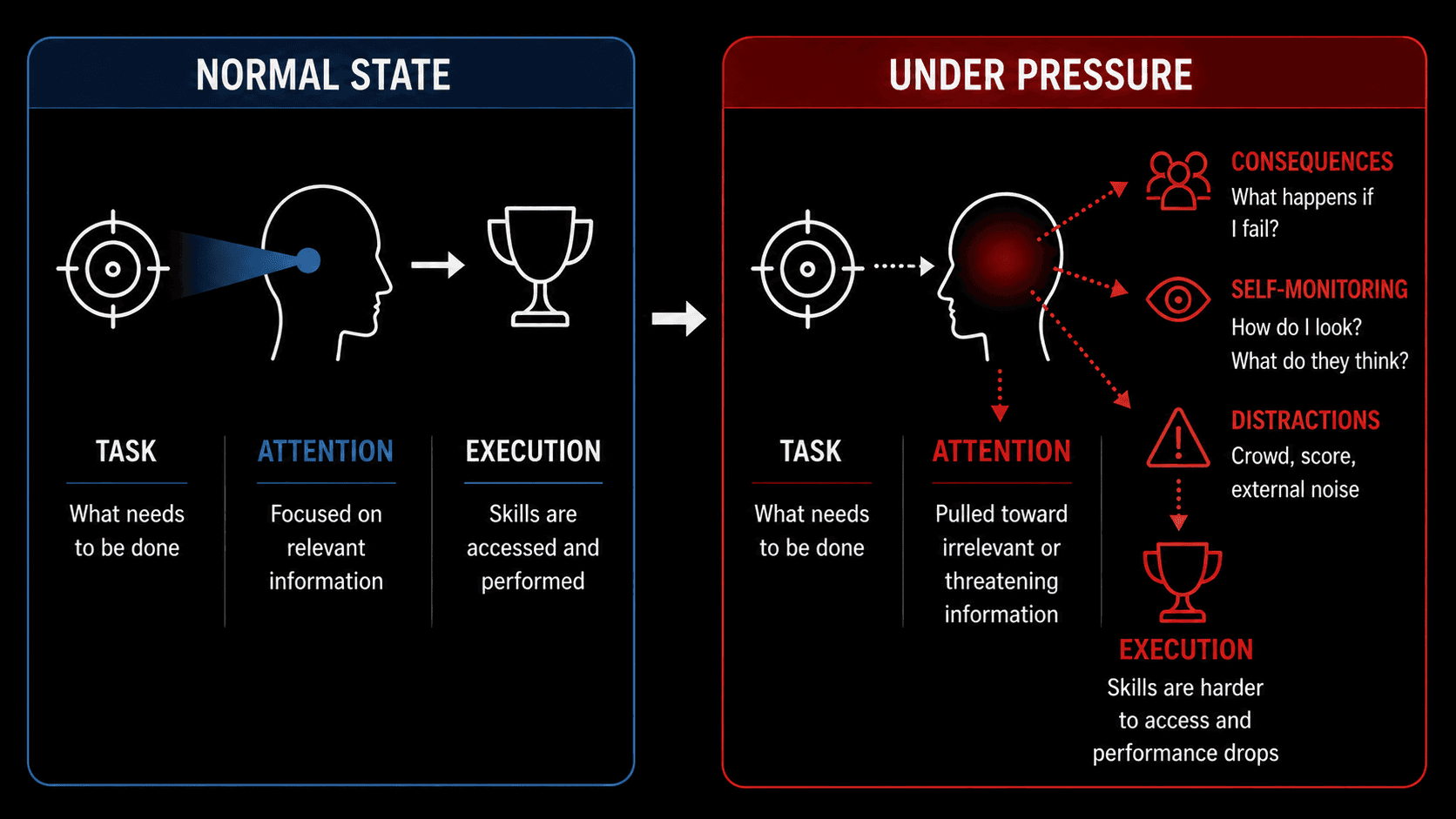
Concept based on Gröpel & Mesagno (2019).
The objective of mental training therefore isn’t to eliminate pressure. It is to develop a more effective response to it, so that the importance of a situation doesn’t unnecessarily interfere with the skills you’ve already developed.
Pressure Isn’t Always the Enemy
Feeling nervous before something important isn’t automatically a sign that you’re going to perform poorly. Increased activation is a normal response to situations that matter, and some activation can be useful: it prepares the body for action, increases alertness and can create the intensity required to perform.
Problems are more likely to emerge when that activation begins interfering with what the task actually requires. For one person, pressure may produce excessive muscular tension; for another, it may lead to racing thoughts, rushed decisions or an inability to stop thinking about the consequences of failure. Someone else might become excessively cautious and start avoiding decisions they would normally make without hesitation.
This is why trying to become completely calm isn’t necessarily the right goal. A sprinter preparing for a race probably doesn’t want to feel as relaxed as they do before falling asleep, just as someone making a complex financial decision doesn’t want so much activation that they become impulsive. The useful level of activation depends on the person and the demands of the task.
A better objective is therefore to recognize the difference between feeling ready and feeling overwhelmed, and to develop tools that help you move back toward a state in which your activation supports rather than disrupts execution.
Pressure Changes Where Your Attention Goes
One of the most important things pressure can change is surprisingly simple: what you pay attention to.
Imagine taking an important penalty in football. During training, your attention might naturally remain on the target and movement. During a decisive competition, however, entirely different information can enter awareness: the crowd, the score, what happens if you miss and what other people will think.
A similar shift can occur in decision-based environments. A poker player facing a large pot might normally evaluate ranges, blockers and the opponent’s tendencies, yet under pressure attention can increasingly shift toward the amount of money involved. A trader can move from evaluating the quality of a setup to thinking about how badly they need to recover an earlier loss, while someone giving an important presentation may suddenly start monitoring how nervous they appear instead of concentrating on what they’re trying to communicate.
Research on choking under pressure broadly identifies two major routes through which this can become problematic: distraction, in which attention is pulled away from information relevant to the task, and self-focus, in which performers begin consciously monitoring aspects of skilled execution that normally operate more automatically (Gröpel & Mesagno, 2019).
The implication is important because performing better under pressure isn’t simply about trying harder. Sometimes trying harder means directing even more attention toward exactly the processes that pressure has already disrupted.
The goal is not maximum concentration. It is attention on the right things.
1. Regulate Your Body Before It Influences Your Decisions
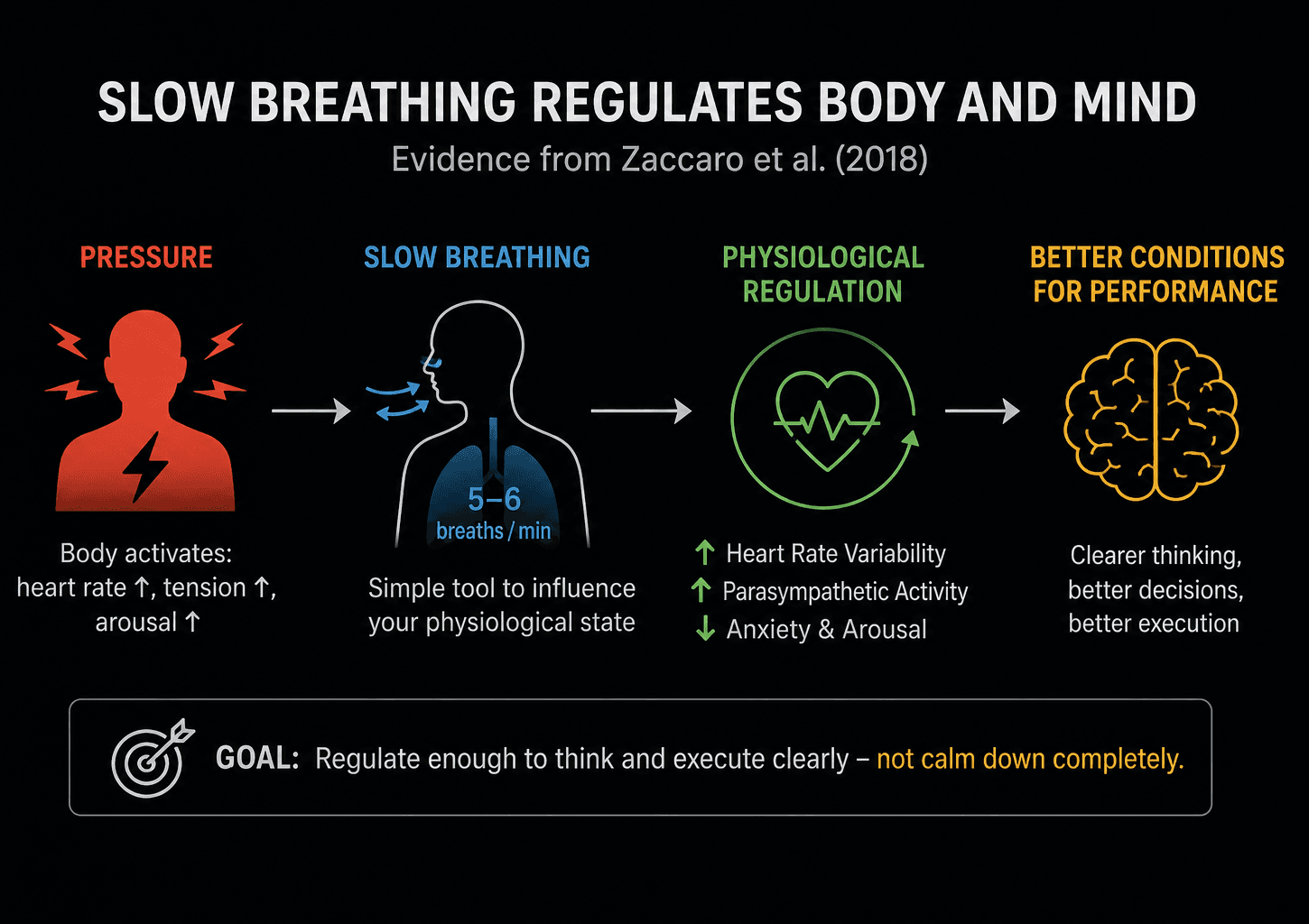
Pressure isn’t exclusively psychological. Your body participates in the response: heart rate can increase, breathing changes, muscular tension rises and the entire system becomes more activated. Because the body and psychological state interact, one way of influencing your response to pressure is to start with something relatively controllable—your breathing.
A systematic review of slow-breathing research found associations with changes in autonomic and central nervous system activity, including increased measures related to heart-rate variability, alongside psychological outcomes such as greater relaxation and reduced anxiety or arousal (Zaccaro et al., 2018).
This doesn’t mean that a few slow breaths will automatically make you perform well, nor should breathing be used to eliminate every sign of activation. Its practical value is that it gives you a relatively simple way to influence your physiological state before or during a demanding situation.
Before a competition, presentation or important decision, slow your breathing and particularly avoid the short, rapid breathing that can accompany excessive activation. In environments such as poker or trading, even a brief reset between decisions can create a useful interruption when you notice yourself becoming increasingly reactive.
2. Stop Fighting Every Negative Thought
Another common reaction to pressure is trying desperately not to feel pressure.
A thought appears:
What if I fail?
You immediately respond:
Stop thinking about that.
Now you have the original concern plus an additional struggle against your own psychological response. The more important it becomes not to feel anxious, the more attention you may end up directing toward whether you’re anxious.
Mindfulness-based approaches take a different route. Instead of requiring difficult thoughts and emotions to disappear before you can perform, the objective is to notice internal experiences without automatically responding to them. Meta-analytic and systematic-review evidence in athletes suggests that mindfulness interventions can improve mindfulness-related psychological variables and may also support aspects of athletic performance, although the evidence for performance outcomes is less extensive than for the psychological measures (Wang et al., 2023).
For performance, the useful idea is straightforward: you don’t need to believe or act on every thought that appears.
You can notice “I’m nervous” without turning it into “I’m going to fail.” You can notice frustration after losing a large pot without immediately changing your strategy, and you can experience doubt before an important competition without interpreting that doubt as evidence that you’re unprepared.
The aim isn’t emotional numbness. It is creating enough distance between an internal reaction and your behavior that you still have a choice about what happens next.
3. Change the Way You Talk to Yourself
Consider the difference between these two internal instructions:
“Don’t screw this up.”
and:
“Focus on the next decision.”
Both may appear in exactly the same situation, but they direct attention very differently. The first emphasizes the possibility of failure without providing useful information about what to do; the second brings attention back toward an immediate controllable action.
Self-talk is more than simply telling yourself that everything will be fine. A meta-analysis of 32 studies and 62 effect sizes found a moderate positive overall effect of self-talk interventions on sport task performance, with effectiveness varying according to characteristics of the task and the type of self-talk used (Hatzigeorgiadis et al., 2011).
Useful self-talk should therefore be credible, specific and connected to execution. If you’re clearly nervous, telling yourself “I’m completely relaxed” may not be particularly convincing. “Slow down and follow the process” gives you something you can actually do. An athlete might use “eyes on the target”, while someone making complex decisions might use “evaluate first, act second.”
A useful question when you notice your internal dialogue becoming increasingly negative is:
Is this thought helping me execute the next action?
If it isn’t, don’t spend five minutes arguing with it. Redirect attention toward an instruction that does.
4. Mentally Rehearse More Than the Perfect Outcome
Visualization is often reduced to imagining yourself winning, but useful imagery can be much more specific than that. Rather than repeatedly picturing the final result, mentally rehearse the actions and responses required to produce a good performance.
A recent systematic review and multilevel meta-analysis covering 86 studies and 3,593 athletes found that imagery practice was associated with improvements in athletic performance across a range of outcomes, while also suggesting that combining imagery with additional psychological skills can be particularly useful (Liu et al., 2025).
Instead of only imagining a perfect competition, imagine yourself encountering a difficult moment and responding effectively. See yourself making a mistake and returning your attention to the next action, experiencing nerves without rushing, or remaining disciplined when the outcome temporarily moves against you. A trader could mentally rehearse following predefined risk rules after a loss, while a poker player could visualize taking enough time before an important decision despite the size of the pot.
This makes imagery less about predicting success and more about rehearsing useful behavior under imperfect conditions.
Real performances rarely unfold exactly as planned. Your mental preparation shouldn’t require them to.
5. Build a Repeatable Pre-Performance Routine
These techniques become more useful when they aren’t treated as isolated tricks. Instead, combine a small number of them into a routine that you can repeat before important situations.
A routine might begin with one or two minutes of controlled breathing to regulate excessive activation, followed by a brief mental rehearsal of the behaviors you want to execute and finally one or two task-specific cues that direct your attention toward what matters. The entire process can be short. Its value comes less from complexity than from familiarity and repetition.
Systematic reviews of choking interventions have identified approaches including pre-performance routines, imagery, attentional strategies and acclimatisation to pressure among the methods that can help protect performance under stressful conditions, although the effectiveness of individual interventions varies with the task and context (Gröpel & Mesagno, 2019). More recent meta-analytic evidence similarly suggests that psychological interventions can reduce pressure-related performance decrements in sport, with stronger and more consistent effects for some task types than others (Zeng et al., 2026).
A simple routine might therefore look like:
REGULATE → FOCUS → REHEARSE → EXECUTE
Regulate your activation, identify what deserves your attention, briefly rehearse how you want to respond and then stop analyzing and perform.
The purpose of a routine isn’t to guarantee that you’ll feel perfect. It’s to provide a stable process when the situation itself feels unstable.
6. Train Pressure Before You Need to Perform Under It
There is one final problem with many mental strategies: people first attempt to use them when they’re already in the most difficult situation they face.
You wouldn’t learn a new technical skill for the first time during a competition, yet breathing, self-talk, attention control and imagery are often treated as emergency techniques that should somehow work immediately when pressure reaches its highest point.
Instead, practice them under progressively more demanding conditions. An athlete can deliberately introduce consequences or competition into training. Someone preparing for a presentation can rehearse in front of other people rather than only practicing alone. Decision-makers can simulate time pressure or review difficult scenarios before encountering them for real.
This approach is sometimes described as pressure acclimatisation. The systematic review by Gröpel and Mesagno (2019) identified acclimatisation-based approaches alongside distraction- and self-focus-based interventions as potentially beneficial for performance under pressure.
The goal isn’t to make every training session stressful. It is to prevent the first truly important moment from also being the first time you’ve practiced executing while uncomfortable.
Pressure Performance Is a Skill
Pressure doesn’t mean that something has gone wrong. If the outcome matters to you, some degree of activation is normal, and sometimes useful. The problem begins when your response to that activation starts changing attention, decisions or execution in ways that interfere with the abilities you already possess.
This is why mental training under pressure isn’t primarily about becoming fearless or eliminating negative thoughts. It is about learning to regulate activation without trying to eliminate it, recognize distracting thoughts without automatically following them, direct self-talk toward controllable actions and maintain attention on the information that actually matters.
Research doesn’t suggest that one technique works equally well for every person and every situation. Pressure is task-specific, and psychological interventions show different effects depending on what someone is trying to perform. But the broader evidence supports an encouraging conclusion: the way you respond to pressure can be trained (Gröpel & Mesagno, 2019; Zeng et al., 2026).
You already train the skills required to perform.
Train your ability to access those skills when they matter most.
Sources:
1. Gröpel, P., & Mesagno, C. (2019). Choking interventions in sports: A systematic review. International Review of Sport and Exercise Psychology, 12(1), 176–201.
2. Zeng, Z., Yan, W., Mohammadi, A., Toumi, Z., Sun, H., & Soh, K. G. (2026). Counteracting choking under pressure in sport: A meta-analysis of interventions. Psychology of Sport and Exercise, 85, 103130.
3. Zaccaro, A., Piarulli, A., Laurino, M., Garbella, E., Menicucci, D., Neri, B., & Gemignani, A. (2018). How breath-control can change your life: A systematic review on psycho-physiological correlates of slow breathing. Frontiers in Human Neuroscience, 12, 353.
4. Hatzigeorgiadis, A., Zourbanos, N., Galanis, E., & Theodorakis, Y. (2011). Self-talk and sports performance: A meta-analysis. Perspectives on Psychological Science, 6(4), 348–356.
5. Wang, Y., Lei, S. M., & Fan, J. (2023). Effects of mindfulness-based interventions on promoting athletic performance and related factors among athletes: A systematic review and meta-analysis of randomized controlled trials. International Journal of Environmental Research and Public Health, 20(3), 2038.
6. Beilock, S. L. (2010). Choke: What the Secrets of the Brain Reveal About Getting It Right When You Have To. Free Press.